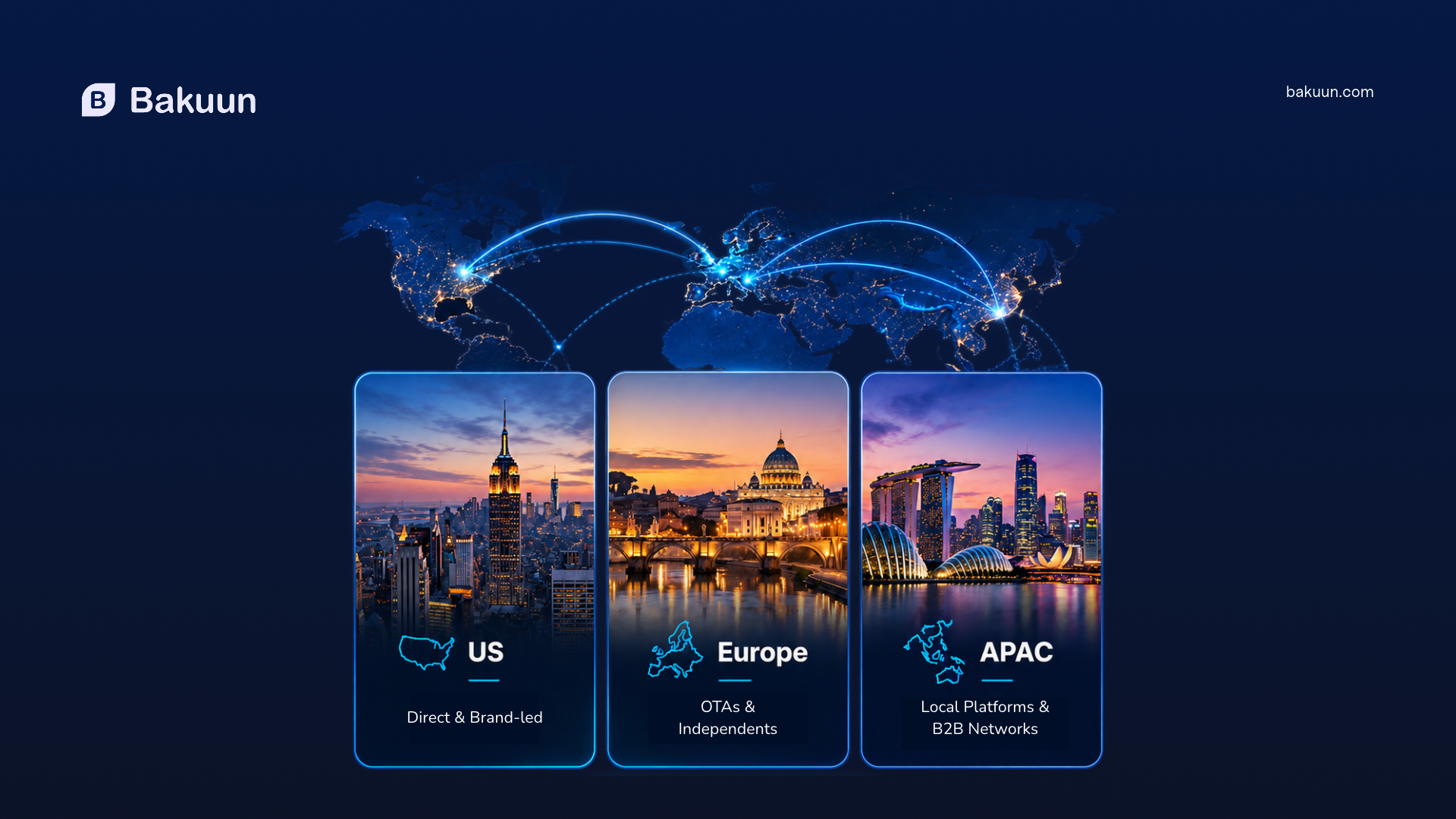


Why is APAC hotel distribution different?
Asia pacific hotel distribution is different because the region is not one market. It is dozens of markets, each with its own languages, currencies, payment habits and leading booking platforms. In the US and Europe, a few global online travel agencies (OTAs) and strong direct channels set the rules. In APAC, rooms sell through a wider web of B2B and B2C partners that changes from one border to the next.
For hotels, wholesalers and travel agencies, this means a distribution strategy built for New York or Paris will leave rooms unsold in Bangkok, Bali or Tokyo. Here is how the three regions compare.
How do US hotels distribute rooms?
US hotel distribution is concentrated, domestic and brand-led. According to SiteMinder’s Hotel Booking Trends 2025 data, domestic travellers made up 77% of US hotel arrivals, and Expedia Group led revenue-generating channels across the US, Canada and Mexico. Large chains balance that OTA reach with strong direct booking, steering guests to their own websites through loyalty programmes and member rates. The payoff is clear: globally, direct bookings grew 4.3% in 2025 and carried the highest average booking value of any channel, at US$516. Yet direct alone is not enough. Global distribution systems (GDS), which handle much of corporate travel, were the fastest-growing channel worldwide at 6.6%, and newcomers such as Trip.com entered the US top 12 channels for the first time. For US hotels, the lesson is to invest in a strong booking engine, metasearch presence and smooth payments, while keeping a balanced mix of direct, OTA and GDS distribution (SiteMinder).
How is hotel distribution in Europe different?
European hotel distribution is shaped by independent hotels, Booking.com and regulation. Europe has many more family-run and independent properties than the US. With fewer loyalty programmes to lean on, many rely on Booking.com for cross-border reach.
That reliance has drawn regulators in. On 13 May 2024, the European Commission designated Booking as a gatekeeper under the Digital Markets Act (DMA), which stops it from restricting the prices hotels offer on other channels (European Commission). Direct bookings remain strong in some markets: in Spain, they ranked among the top two revenue channels in 2025 (SiteMinder).
What makes APAC hotel distribution unique?
APAC hotel distribution is unique because four forces work at once: local champions, source-market OTAs, mobile-first buyers and a strong B2B wholesale layer.
Regulation is also local. In January 2026, China's market regulator opened an antitrust investigation into Trip.com (Trip.com Group).
How Bakuun helps hotels and travel buyers win in APAC
Bakuun is a B2B travel platform that combines distribution, connectivity and settlement on one infrastructure. It is built for exactly the kind of fragmented, multi-partner market that APAC is.
Because APAC's travel growth deserves distribution as connected as its markets.